Feeling the Pelvic Clock
If action helps me not to feel, what will help me feel? (I’m standing with my feet wide and planted, knees soft, hips swirling counterclockwise passing 12, 9, 6, 3, and again. My head stays on an even plane, a cork bobbing on water, as Moshe Feldenkrais put it.)
Let’s say I was willing to feel. What would allow me to feel? No action? What are its different forms? There’s immobility, stillness, anchoring, roots, rest, quiet, freeze, held, held back, cemented, waiting, pause, poised, on the brink. Each brings an emotional throb of varying intensity, mild interest to strong aversion.
So maybe. Or maybe it’s action done differently. A change in tone, attitude, frequency, quality, quantity, attention, scale, intention.
A full clock with my hips is so easy to make big:
aaallllllllllllllll the way,
aaaalllllllllllllllllllllllllllllll
the hours, minutes, moments
of sensation, yes, and also
occupation and
distraction.
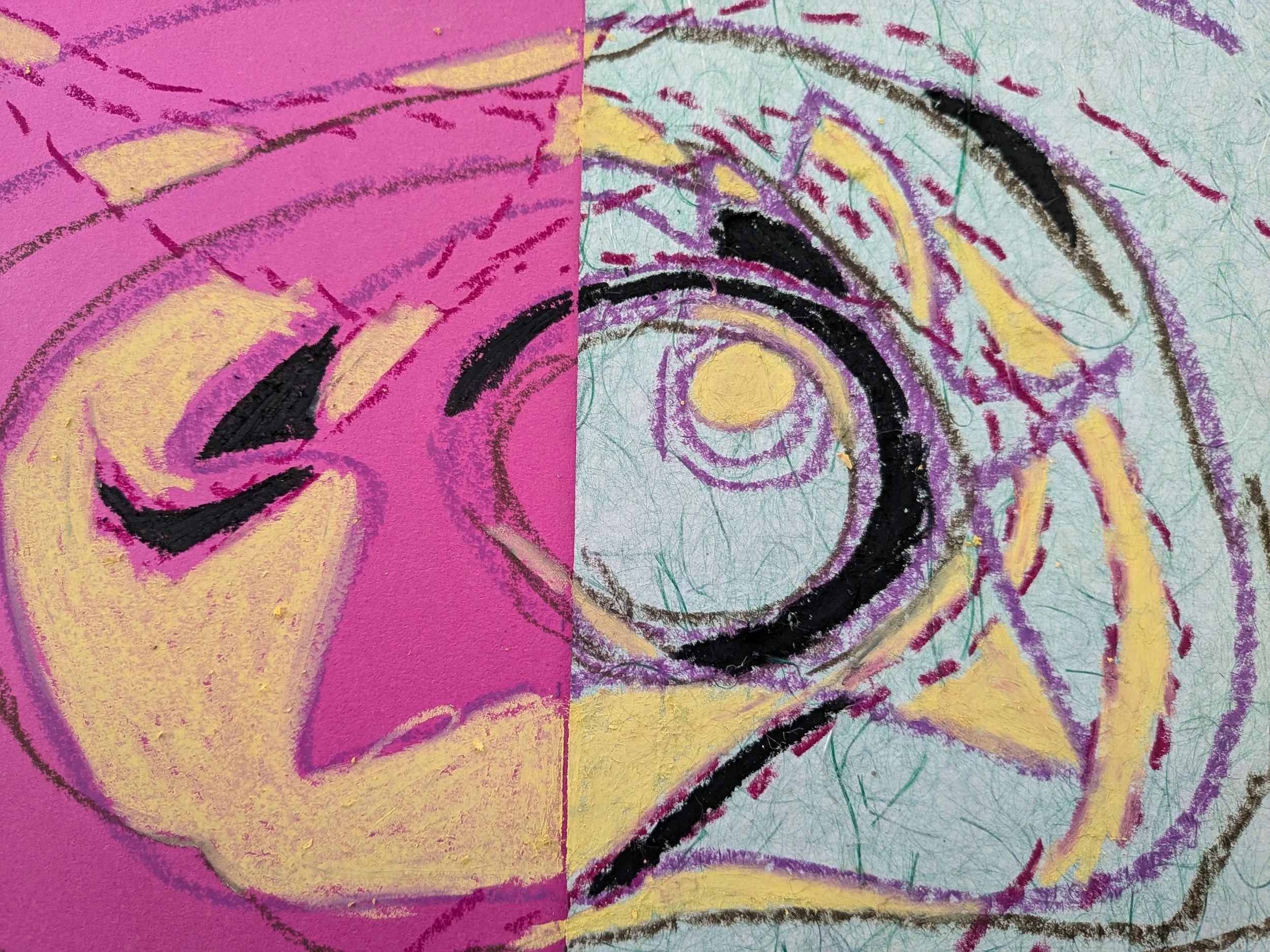
Image description: swirling and crisscrossing lines of purple, red, and brown and amorphous shapes of yellow and black on a background that is bright pink on the left side and pale green on the right side.
What is it like made small? A clock barely perceptible inside, not visible outside. (I’m standing with feet planted wide, eyes closed, sensing the circling in my mind’s eye, which lends the slightest suggestion of movement to my hip joints.) If my clock is not visual, will I get credit? Do I need credit? Perhaps my credit locker is full and no more can even fit. After all, 99+ = :-)
My pelvis likes counterclockwise. It’s easy to make the clock big and smooth, easy enough to skip over feeling. What about the other direction?
3, 5, 7, 9
(I’m circling my hips clockwise and it feels jerky. It’s not smooth, but pointy-cornered. I try to smooth it out, touch all the minutes.)
3, 4, 5, 6
3, 3:30, 4, 4:30, 5, 5:30, 6
3, 3:15, 3:30
Shaved-off curves.
Rush: desire.
Fatigue. Boredom.
BIIIIIIIIIIGGGGGGG!!!
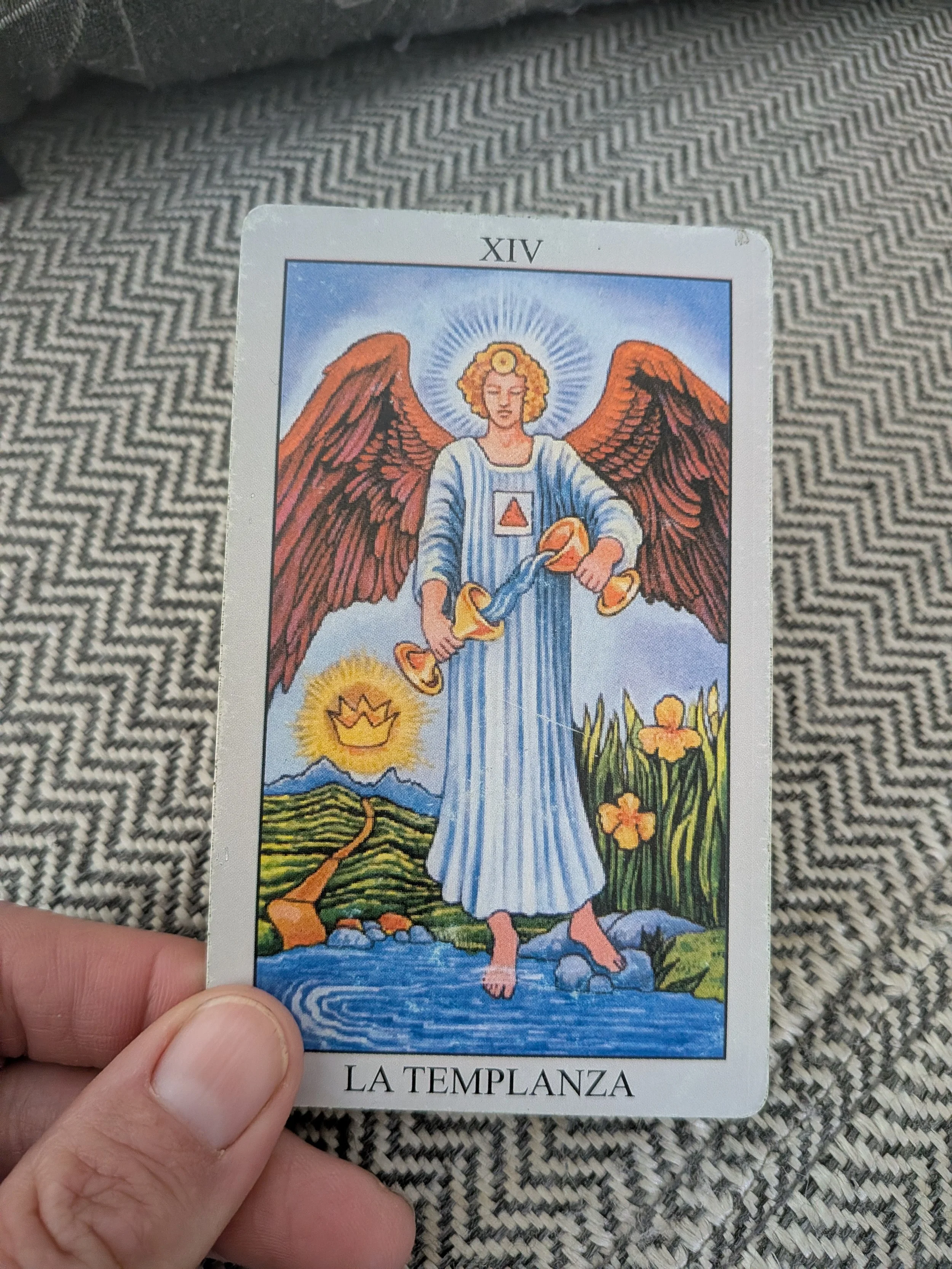
Image description: a tarot card, XIV, La Templanza. A person with widespread, rust-colored wings stands with one foot in a small pool of water and pours water from one golden cup into another.
How does big dampen the feelings I don’t want to feel and the sensations I don’t want to sense? Do my hypermobile joints go big because they can’t sense their limits? How can I tolerate small? Yes, tolerate; it’s a big leap to pleasure and joy, and didn’t I just say small?
I pull La Templanza, Temperance. Measure out, measure out. Draw in the corners. Attend to the amorphous middle. (Okay, I won’t push it. I’m lying on my back, legs outstretched, face toward the ceiling.) How can I ever repay gravity for all it’s done for me?
Lumbar spine
lettttttttting
go
onto the floor.
Pelvis, sacrum
meltttttttttttttttting
into a pool.
It can’t be repaid, isn’t asking to be repaid. This is what is called a gift. Use it, relish it, get a smile or a sigh from it. Could I tolerate small if it were just a small gift? It’s more tolerable than a large gift. But the benefit of big action is that it mutes the small, soft, hurting unfairness. Big cools and numbs the scald of separation, disappointment, rage, injustice. Okay so I have the what. Now can I add the what else?
Let’s say I was willing to feel. Could I let myself receive a small gift? Could I relish the melting without hustling to repay it? Could I accept the sometimes smoothness sometimes pointy-corneredness of being a body in an amorphous middle? Could I make my self-expression barely perceptible and laugh with the goofy grin of my 99+ credits?
(I’ve returned to my feet, dancing now and hitting random numbers on the clock. I’m skipping, darting, dipping. It’s action done differently and I’m feeling it.)
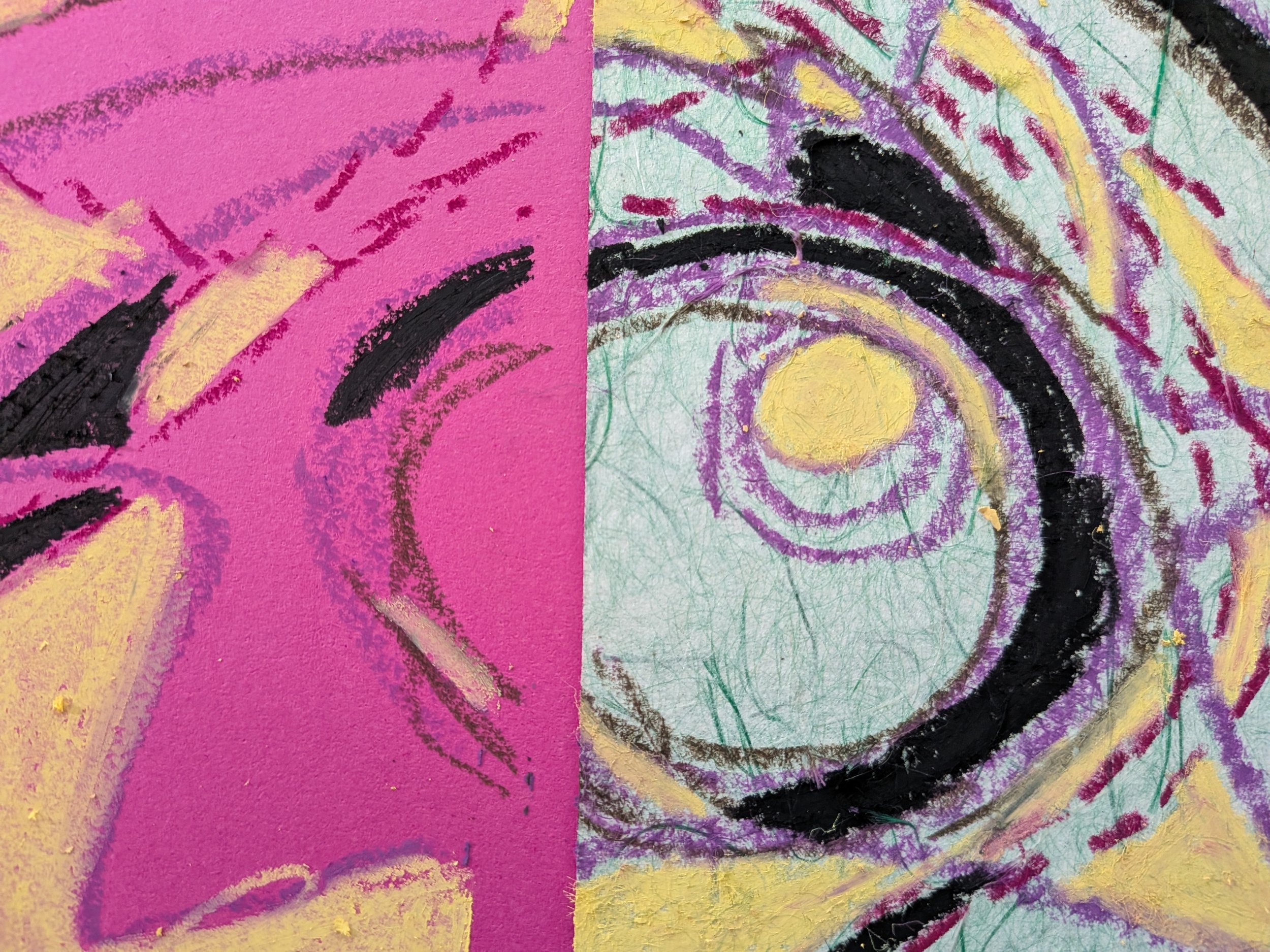
Image description: a closer-up view of the first image at the top but now the pink paper has shifted away from the green paper to the left, showing a blank background and leaving a gap between the lines and shapes that were drawn on top.
References
1 Pelvic Clock is a classic Awareness Through Movement lesson created by Moshe Feldenkrais
2 cork bobbing on water, in The Potent Self by Moshe Feldenkrais